
Nutri-Score

Nutri-Score: Everything You Need to Know
Comparing two products or creating a balanced basket has never been easier thanks to Nutri-Score! The Nutri-Score label consists of 5 letters and 5 colors that summarize the nutritional information of a product. The Nutri-Score logo is based on a scientific algorithm that takes into account nutrients to favor (such as fiber, protein, fruits, and vegetables) for a balanced diet, and nutrients to limit (such as calories, saturated fats, sugar, salt).
How is Nutri-Score calculated?
*From January 2024, all new Delhaize products will be evaluated according to the updated Nutri-Score algorithms.
More information on this will be available soon.
Nutri-Score applies to products as they are in their packaging, meaning as they are sold.
If you transform the product at home, for example by frying it or adding sugar, the Nutri-Score will change according to the preparation.
Nutri-Score is calculated per 100 g or 100 ml. This allows you to easily compare products within the same category. Of course, we don’t always eat exactly 100 g or 100 ml of a product. That’s why it’s important to keep the food pyramid in mind—it helps ensure a varied and balanced diet.
So, you don’t need to choose only products with Nutri-Score A and B, or reject D and E products. For example, vegetable oils and fats in mayonnaise or margarine often have a D or E score because they are high in fat and calories. But for cooking or preparing a salad, you usually need only a tablespoon or teaspoon, far from 100 g or 100 ml.
Let’s calculate as an example the Nutri-Score of Delhaize’s Chocolate-Hazelnut & Stevia Granola:
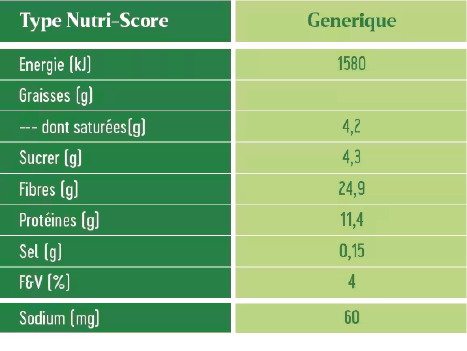 |
Step 1Take the nutrition table (per 100g). Note that this example uses the generic Nutri-Score calculation model. From 2024, there are 5 models: general, drinks, cheese, red meat, and fats, nuts & seeds. |
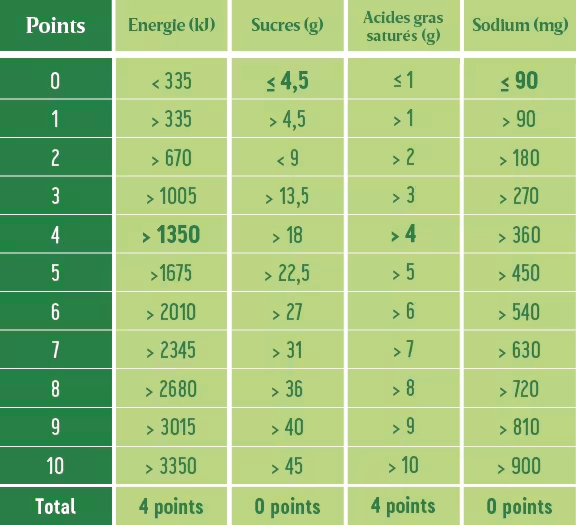
Step 2Assign points to each item in the nutrition table based on two scales. In this second step, you calculate points for nutrients considered unfavorable for Nutri-Score. |
 |
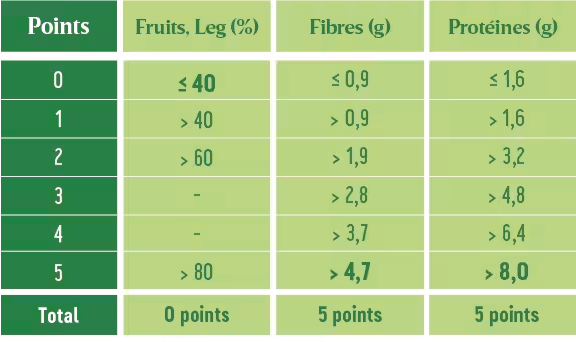 |
Step 3Assign points for nutrients considered favorable for Nutri-Score using two scales. |
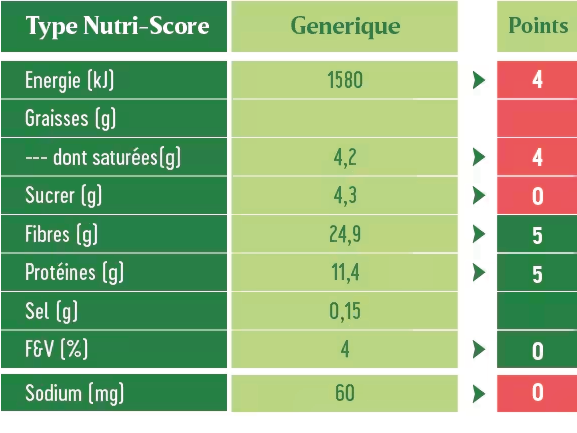
Step 4Add up the points for unfavorable and favorable nutrients separately. |
 |
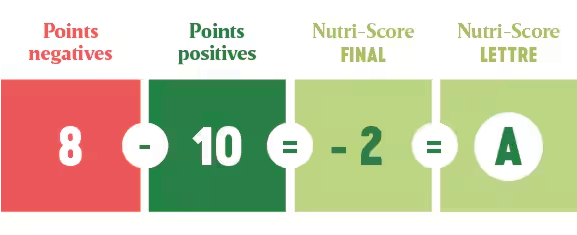 |
Step 5Then subtract the total points of unfavorable nutrients from the total points of favorable nutrients. |
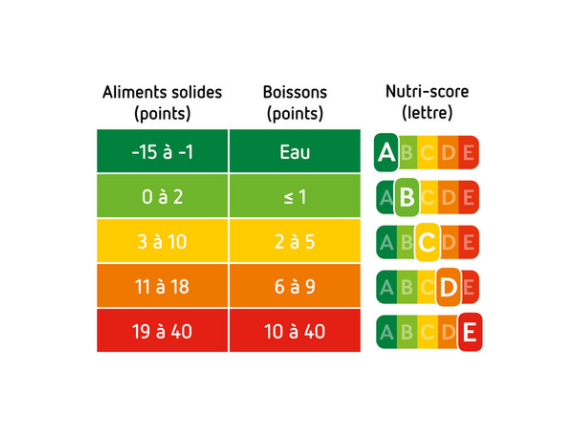
Step 6Refer to the Nutri-Score table. Our final score for Delhaize’s Chocolate-Hazelnut & Stevia Granola is -2, which corresponds to letter A on the Nutri-Score chart. |
 |
At Delhaize, our goal is to improve the Nutri-Score of your favorite products
How do we improve the Nutri-Score of your favorite products?
1. A team of dietitians analyzes the Nutri-Score of our product range and identifies products that could achieve a better score.
2. The composition of each selected product is analyzed. The goal? Adjust the recipe by reducing salt, sugar, or fat and increasing fiber or protein content.
3. We then consult our suppliers to see how the original recipe can be modified, ensuring we improve products without changing their taste, color, or texture.
4. Samples of the new products are presented to a panel of tasters. They are compared to our current products and sometimes competitors. Samples are also tested in a lab to ensure nutritional values match the improved Nutri-Score.
5. If the tasting is successful (the product is judged at least as good or better), the composition is modified, and new packaging is printed so the product is available in stores as soon as possible.
 |
 |
 |
